Driveway & Pathway Cleaning In Melbourne
Driveway & Pathway Cleaning Experts
Pressure washing, house washing and exterior cleaning across Frankston, the Mornington Peninsula and Melbourne's south east.
TopTier Exterior Service cleans driveways and pathways across Frankston, the Mornington Peninsula and Melbourne's south east, on plain and coloured concrete, exposed aggregate, stencilcrete, brick and concrete pavers. A driveway is the largest single surface on most properties and the first thing anyone sees from the street, and it is also the surface most often ruined by cleaning rather than by wear. Wand marks, the pale stripes left when someone cleans concrete with a hand-held lance instead of a rotary surface cleaner, are permanent, and they are the single most common complaint about this trade. We clean flat work with a surface cleaner in overlapping passes for an even finish, pre-treat oil and organic stains separately, and can seal afterwards where the surface warrants it. Call Razz on 0430 392 100.
GET A FREE QUOTE
TopTier Exterior Service
The Surfaces We Clean
Four surface types cover almost every driveway and path across Melbourne's south east. Plain concrete driveways are the most common, particularly on the established stock through Frankston, Seaford, Carrum Downs and Langwarrin, and while concrete is tough, it is also porous, which is why black algae and lichen root into it rather than sitting on top. Pavers and brick paving are the second group, on both older properties and newer estate courtyards, and they bring their own issue in the joints, since cleaning inevitably lifts jointing sand and it has to be re-swept afterwards or the pavers start moving. Exposed aggregate is the third and it is everywhere on the newer builds at Clyde, Clyde North, Cranbourne and Berwick; it needs care because the decorative stone sits in a cement matrix that high pressure held too close will erode, loosening the stones permanently. Stencilcrete and coloured concrete is the fourth and the most fragile, since the pattern and colour live in a surface coating and sealer that will strip under aggressive cleaning, taking the whole look of the driveway with it. Beyond driveways we clean footpaths, side paths, crossovers, garage aprons, shed slabs, pool surrounds, courtyards and steps, which pair naturally with a house wash.
TopTier Exterior Service
How We Clean and Protect
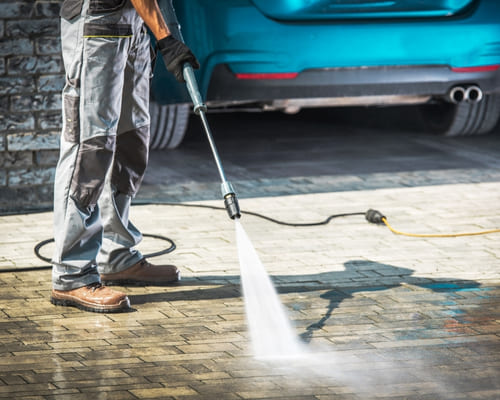
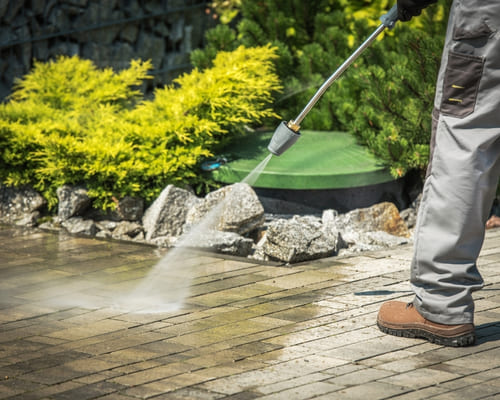
The method has three stages and each one exists to avoid a specific failure. Pre-treating oil and organic stains comes first, because these are two different problems needing two different chemistries. Oil, transmission fluid and tyre rubber need a degreaser worked in and given dwell time to draw the contamination out of the concrete pores, since blasting an oil stain simply drives it deeper. Organic growth, the black film and lichen, needs a cleaning solution that kills it biologically at the root, which is what stops it returning within one wet winter. Both need to sit before any machine touches them. The surface-cleaner pass is the second stage. Flat work is cleaned with a rotary surface cleaner, an enclosed head that spins jets at a fixed height and distance and travels in overlapping passes, so the entire slab receives identical treatment and the finish is even edge to edge. Detail work around edges, steps and up against walls is done by hand and blended in. The third stage is optional: sealing after cleaning. A sealer applied to a properly cleaned and fully dry surface reduces how much the concrete absorbs, slows organic regrowth and makes future cleans easier, and on exposed aggregate it also locks stones in place. The numbers are straightforward. Flat work runs at 3,000 to 4,000 psi at about 15 to 21 litres per minute through a 400mm to 500mm rotary surface cleaner, which fixes the jet height and travel so the energy delivered per square metre is constant. Degreasers on oil need 10 to 15 minutes of dwell before the pass, and organic treatments the same. Sealer only goes onto a surface that has been dry for 24 to 48 hours, and most concrete sealers want re-coating every 3 to 5 years.
TopTier Exterior Service
Why Wand Marks Ruin a Driveway
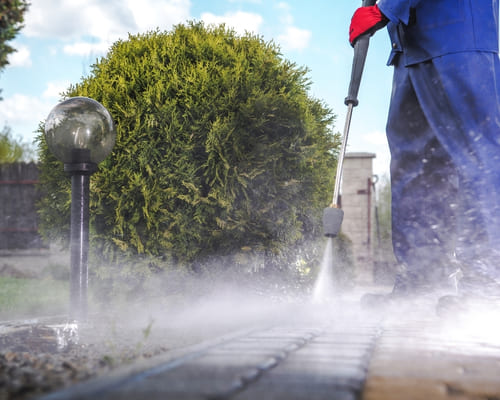
Wand marks are worth explaining properly because they are permanent, they are the most common way a driveway gets wrecked, and they are entirely avoidable. A hand-held pressure wand concentrates all the machine's output into a narrow fan, and the operator sweeps it across the slab by arm movement. Wherever the wand paused, sat closer, or overlapped a previous sweep, the concrete received more energy, and that shows up as a pale stripe or arc against the surrounding surface. The cause is that the cleaning is not really removing dirt at that point, it is removing a thin layer of the concrete surface itself, so the stripe is a physical difference in the slab rather than a difference in cleanliness. No amount of subsequent cleaning removes it, because there is nothing left on top to remove. The same mechanism erodes the cement matrix around exposed aggregate and strips the coating off stencilcrete. A rotary surface cleaner solves it by fixing the jet height, the distance and the rotation speed, so every square centimetre gets the same treatment as it passes. TopTier uses one on all flat work as standard, and Razz does the job himself rather than sending someone to learn on your driveway. Call 0430 392 100 for a written price.
TopTier Exterior Service
What Driveway Cleaning Costs
Driveway and pathway cleaning is quoted by measured square metre, and understanding the variables lets you compare quotes honestly. The base number is total area: driveway, crossover, side paths, front path, courtyard and any slab you want included. The shape then matters as much as the size, because one large open driveway a surface cleaner can run straight across is far quicker per square metre than the same area broken into narrow paths, steps, curves and tight corners that have to be worked by hand. Surface type moves the price, since exposed aggregate, stencilcrete and pavers all need more care and slower work than plain concrete, and pavers add the re-sanding of joints at the end. Condition is the next factor: light dust is a fast job, while a shaded south-side path carrying years of established black lichen needs pre-treatment, full dwell time and often a second pass. Stains are quoted individually because each needs its own chemical, so oil, rust, paint drips and tyre rubber are listed separately rather than bundled into a vague allowance. Access affects the price too, as a trailer that can park within hose reach costs less than one running long lines down a side path. Sealing is a separate quote. Send photos and dimensions to 0430 392 100.
TopTier Exterior Service
Clean Only vs Clean and Seal
Whether to seal after cleaning is a genuine judgement call rather than an automatic upsell, so here is the honest version. Cleaning only is the right choice on a sound plain concrete driveway in reasonable condition, where you are happy to book a clean every year or two and would rather not spend more upfront. Concrete does not need a sealer to survive, and an unsealed driveway that is cleaned on a rhythm will look good indefinitely. Cleaning and sealing makes sense in three situations. The first is decorative surfaces, exposed aggregate, stencilcrete and coloured concrete, where the sealer is part of the original finish, has worn off, and the surface now looks dull and is absorbing stains it was never meant to absorb. The second is heavy shade, since a sealed surface is less porous, so algae and lichen have far less to root into and regrowth slows noticeably. The third is stain exposure, on driveways where cars leak, bins sit, or trees drop fruit and sap, because sealed concrete releases those stains far more readily. The caveats are real: sealer must go onto a fully cleaned, completely dry surface, it needs re-application every few years, and a sealer applied over a poor clean locks the dirt in permanently. We will tell you which your driveway warrants. Driveways are most often booked alongside a house wash or gutter cleaning in the same visit.
Related Driveway & Pathway Cleaning Services in

Driveways, paths, patios, walls and fences across Frankston and the Peninsula, cleaned at the pressure each surface will actually take. Even passes with a surface cleaner, no wand stripes, no etched render, and a written price before we start.
Render, weatherboard, brick and cladding washed properly across Melbourne's south east. Low pressure, right chemistry, mould and lichen killed at the root rather than just knocked off, so the walls stay clean through the next wet winter.
Moss, lichen and algae taken off concrete tile, terracotta and Colorbond roofs across Frankston and the Peninsula, at pressure the tiles will actually survive, with the gutters cleared down afterwards so nothing is left sitting in them.
TESTIMONIALS
What Our Driveway & Pathway Cleaning Customers Say About Us
The Process
3 Step Process For Your Driveway & Pathway Cleaning Needs

Send Photos
Text or email a couple of photos of the surfaces you want cleaned. We come back with a written price, usually the same day.

We Clean
We arrive at the agreed time, protect plants, drains and fittings, then work through every surface in the scope from top to bottom.

Walk Round
We walk the property with you before packing up, so anything you are not happy with gets put right there and then.
Driveway & Pathway Cleaning In
FREQUENTLY ASKED QUESTIONS
Everything you need to know about our Driveway & Pathway Cleaning In
How much does driveway cleaning cost?
Driveway cleaning is quoted by measured square metre, so we need the total area of the driveway, crossover, paths and any courtyard or slab you want included. Shape matters as much as size, because one open driveway a surface cleaner can run across is much faster per square metre than the same area split into narrow paths, steps and tight corners that have to be hand worked. Exposed aggregate, stencilcrete and pavers cost more than plain concrete because they need slower, more careful work. Individual stains such as oil, rust and paint are priced separately. Send photos and dimensions to 0430 392 100.
Can you remove oil stains?
Usually to a significant degree, though how far depends on how long the oil has been sitting and how deep it has soaked. Concrete is porous, so oil, transmission fluid and grease draw down into the slab rather than sitting on top, which is why blasting an oil stain does nothing useful and often drives it deeper. The right approach is a degreaser worked in and given real dwell time to pull the contamination back out of the pores, sometimes over more than one application. Fresh stains generally come out fully; a stain that has been there for a decade under a leaking car will lighten considerably but may not disappear entirely.
Will cleaning damage exposed aggregate?
Not the way we clean it, but it certainly can be damaged by careless cleaning, which is why it is quoted differently to plain concrete. Exposed aggregate is decorative stone held in a cement matrix, and a high-pressure wand held too close erodes that matrix and loosens the stones permanently, so what starts as a cleaning job ends as a resurfacing one. Cleaning it properly means a rotary surface cleaner at a controlled height and pressure, in even passes, with the chemistry doing more of the work than the force. If the original sealer has worn off, which is common on aggregate, re-sealing afterwards is worth considering to lock the stones in.
How long does a driveway take?
A standard single or double driveway with the front path is usually a two to three hour job, including the pre-treatment and the dwell time that makes the result last. Larger areas, heavy lichen needing a second pass, or a lot of hand-worked detail around steps, edges and curves all extend that. Paver jobs take longer again because the joints have to be re-sanded afterwards. If we are sealing as well, the surface has to be completely dry first, which in Melbourne usually means returning on a separate day rather than sealing the same afternoon. You get a time window when the job is booked.
Should I seal it afterwards?
It depends on the surface. A sound plain concrete driveway does not need sealing, and cleaning it every year or two will keep it looking right without the extra spend. Sealing genuinely earns its cost in three cases: on decorative surfaces such as exposed aggregate, stencilcrete and coloured concrete where the original sealer has worn off and the finish now looks dull, on heavily shaded driveways where reduced porosity slows how fast algae roots back in, and where cars leak or bins sit and staining is a recurring problem. The important condition is that sealer must only go onto a properly cleaned, fully dry surface, or it locks the dirt in permanently.
How often should a driveway be cleaned?
Every 12 to 24 months for most properties across Frankston and Melbourne's south east, with shade being the deciding factor rather than the calendar. A north-facing driveway in full sun can comfortably stretch to two years; a south-side path under tea tree or eucalypt canopy that never fully dries often needs annual attention. Sealed surfaces stretch the interval further. There is a safety argument for not leaving it too long, because a film of algae on smooth concrete becomes genuinely slippery through a wet Melbourne winter and is a common cause of falls, particularly on sloped driveways and steps. Regular cleaning also costs less per visit.
Request A Free Driveway & Pathway Cleaning Quote
GET A FREE QUOTE
BUSINESS
SERVICES
SERVICE AREAS
OPERATING HOURS
Sun: 7:00am - 9:00pm
Mon: 7:00am - 9:00pm
Tue: 7:00am - 9:00pm
Wed: 7:00am - 9:00pm
Thu: 7:00am - 9:00pm
Fri: 7:00am - 9:00pm
Sat: 7:00am - 9:00pm